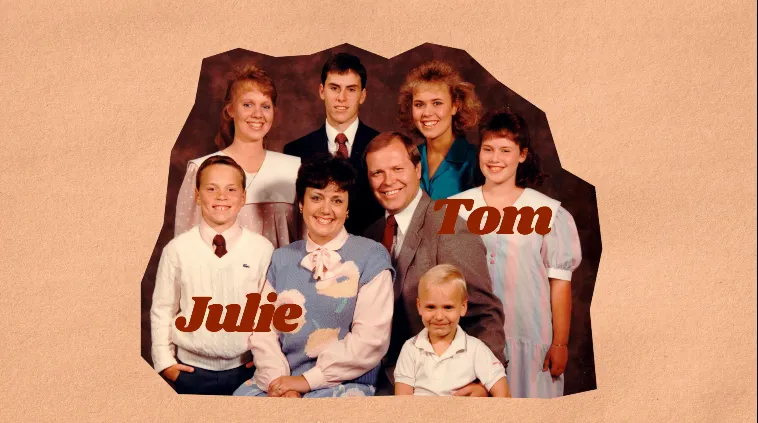
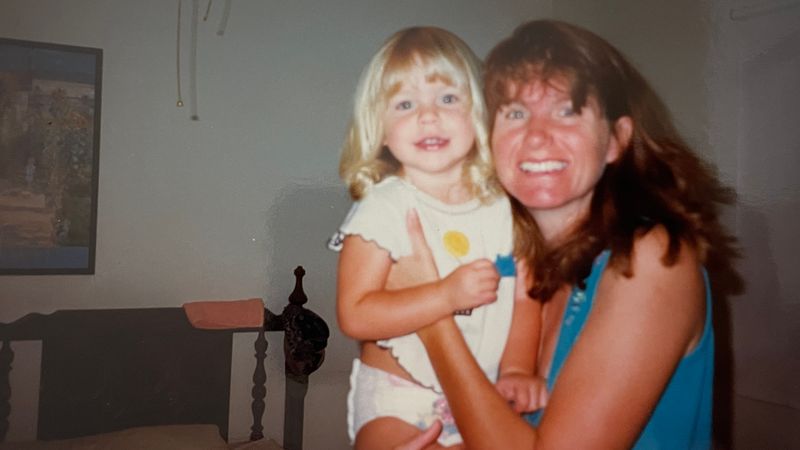
Tom and Julie Darling, the parent's of 6 children, Amy, Joan, David, Jennifer, Michael, and Stephenson.
They met around age 6 (yes SIX) in Oregon, Tom and Julie lived very different lives growing up. Tom learned very early the meaning of hard labor. If chicken was on the menu for dinner, that chicken was roaming their property an hour before it was on the plate. Julie had a different upbringing where she learned her own set of principles, as Julie put it, she was "spoiled", maybe the chicken just "appeared" on the plate.
These opposite experiences were a perfect match for the two, they are now going on their 60th year of marriage.
Leaning heavy on their faith, they raised 6 children all while dealing with layoffs and packing up their lives numerous times to move across different states with one thing for certain. Making it work.
Tom and Julie kindly share stories of their parenting lives and what it took through different hardships to have a successful relationship together as well as with their six children.
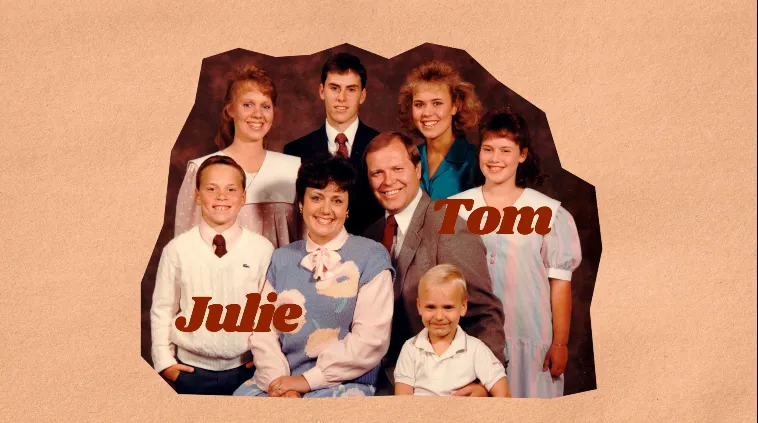
The Darlings
Jake:
Can you say your names and who your kids are.
Tom:
You can name them, I forget them.
Julie:
Tom and Julie Darling. We have six children. Amy Ann, Joan Vellas, David Thomas. Jennifer Lee, Michael Folger, and Stevenson Pratt.
How was your relationship with your own parents?
Julie:
Well, my upbringing was very different from Tom's. Tom lived on a farm where he had to work. "Root hog or die", as Opal [Tom's mother] would say. He'd get sent out to get some chicken for dinner, and they'd chase them down in the yard, cut off their heads, skin and clean them, and bring them in for Opal to fry.
I mean, it was just so different, because my mother had a cleaning lady. She had an ironing lady. My dad was home every day at 4 o'clock. I remember my dad playing with me a lot. We would play pick up sticks, or marbles, or things like that, and he was really involved.
The thing I would do differently, and that we did do differently, is we were very active in the kids' schools, and my folks weren't.
Ramsay:
Do you mean, like PTA or...?
Julie:
Yeah, no, they weren't very involved in that. And we made a point of really being involved with the kids at school.
But education was very important to my dad. You know, he was unable to go to college, but he was a self made man. And we always had plenty. I never had to worry about anything.
Mothers health was quite frail, but I'd see her get up, and, oh, go teach a Sunday school class, or whatever, and I'd say, "Mother, why?" I mean, I come home from school, and she'd be reading Josephus for pleasure. Yeah, she was very, very bright.
And... I would ask "Why do you do that? Why do you get up? Why don't you call a substitute? Why don't you just say you're ill?" I mean, I saw her get up literally out of a sick bed.
She'd say "because I need the blessings. Blessings are predicated upon obedience."
She'd go and teach the class and she'd be fine. So she didn't play a lot with me.
But, oh, I was a spoiled brat. And I look at some of the things I did and said, and I think, if one of my kids has said that to me, they'd had been flat backed with his foot in their throat.
But they loved each other. And I saw my dad take care of my mother, through dementia, and it was just amazing.
But, yeah, he thought he was right downtown when he had a two seater outhouse, and I didn't even know what an outhouse was. So we grew up from very, very different backgrounds.
But we somehow, I guess it was through seminary. There's a class before church, and my dad would wake me up, and then he'd go clear out to South Salem and pick up the kids and come back and get me so I could sleep 10 minutes longer or 20 minutes longer. I mean, I was really very indulged and lived an indulgent lifestyle.
But I think he was pretty much your father figure, wasn't he?
Tom:
Yeah.
My dad died in my junior, senior year.
Julie:
You had just turned 15. 16.
Tom:
We were in Salem, Oregon. She was originally here [Arizona], married my dad out in...
Julie:
She was a rosie riveter.
Tom:
Out in Goodyear, where they made B 52s and all this kind of stuff. And they met there. She married her boss. She had had previous relationships. She had three other children. I'm the only one with my father.
Well, there was not much affection from my dad.
Mom, both of them were, very hard working people.
Julie:
House was always clean.
Tom:
My dad had come from Kansas originally, was a farmer there.
I don't know if the very much parenting ever took place there. My mother was the enforcer of the family. She had a very large brown leather belt that was the enforcement instrument. However, the boys weren't really very rebellious.
We learned to work very soon in life.
As Julie said, you know, we lived on this farm. We cleared the timber off the lawn. We grew... corn, potatoes, beans, squash, carrots, berries.
We didn't have any money. We didn't have any money, and dad worked as a mill ride at Oregon Pulp and Paper, in downtown Salem. Mother worked in care facilities, known as old folks' home at that point in time, but eventually worked at the Salem State Hospital.
After the mill closed there, My dad worked at the state hospital with her,
Julie:
He remembers his father picking him up one time. That was for a picture.
Ramsay:
Wow.
Julie:
Nothing to do with him. He's been self sufficient since he was 16. His mother moved to California...
Tom:
After Dad died, I had an older brother that had gone to BYU, met a young lady and had since moved to Downey, California. He worked for his father in law in a drapery business, and mother, was a seamstress. She sewed our clothes, our shirts and pants, and we worked the summers.
We worked in the fields, at six years old, I was out picking berries and so on, and we used that money to buy a new pair of shoes, to go back to school.
Julie:
A one room school, by the way.
Tom:
But we walked...
Julie:
Yes, that upbringing is so different from mine.
Tom:
We walked from our home. Two miles down the road to the Hazel Green School.
Julie:
Tell them what you and your brothers did? They drank water all day long so they could pee the line home.
Tom:
That's one of our finer moments.
Julie:
Well, what are four boys gonna do? They're gonna pee their way home. When one left off, the other started.
Ramsay:
When you had kids, were you like, "I'm not doing this." I'm sure with his dad…
Julie:
The opposite of his father.
Ramsay:
Yeah.
Tom:
Yeah, and that, has been a real, a real motivation. I knew what kind of a parent I wanted to be.
If you want to get down to, really, what comes to be the firm foundation of not only a relationship, but also for your children, is a firm foundation. that you establish, and it begins with you.
It begins with you.
Kids have to have a moral compass. And expectations. You know, as I went through your questions, I thought, in reality exactly what has made us in our 59th year of marriage...
Julie:
60th.
Tom:
We're 59 now.
Julie:
Yeah, we're 59 last month.
Tom:
But what it was was the teachings of the Church of Jesus Christ of Latter Day Saints.
Did you have a philosophy going in to parenting?
Julie:
I jokingly said the reason we had six kids is 'cause he loves his kids. He was active with them. He ran with David every night after work, didn't matter how tired he was, to teach David that he could do hard things. I don't think he ever missed a ball game of Michael's.
I did. I'm not going to Lebanon, Oregon, that smelly place.
But it's interesting. I talked to Joan a minute, and I said, "what do you remember the most about growing up?" And she said, "Oh, Dad and I watching sports. He taught me all the rules of all the games. He taught me the rules of tennis. He taught me the rules of football and baseball.
And that's put her in good stead because now she's an empty nester. And she and her husband go to all the games, or watch the games, or when her husband was coaching tennis. She knew the rules because of her dad.
And the reason our six kids have turned out so well, honest and truly, sitting right by me. He was just real active in their lives.
He'd come home, sink would be full of dishes or whatever. He'd never complain. He'd pick up the baby and go upstairs and rock the baby while I cleaned up, or... he went in and started doing the dishes. There was no women's chores and men's chores. They were our chores. They were our children. He was never babysitting. They were his kids, you know?
Tom:
Yeah, I remember out running around the track with David. He said, "Dad, what, what should I do?"
And I said, Well, you can do anything that you want to do." He took that literally. He could do anything.
Julie:
He has a pellet plant. He has a car wash. He has the condos going up down on Power. He has Il Forno Bello, the pizza parlor. What else does he do?
Oh, medical, his main gig is medical equipment. Do you know how he did that? That was really interesting. At least to me. He didn't know how to get into the hospital to get the doctors to use this relatively new piece of new equipment that they put chests and ribs together.
And he found out what color scrubs were at the individual hospitals. Bought a set, went in, schmoozed all the doctors in the operating room.
Tom:
As far as raising kids, Brigham Young... stated it. He was asked at one time by a newspaper, "Brigham, how do you control all these thousands of people?"
His answer... "We teach them correct principles, and they learn to govern themselves." Truth.
That is how you raise your children. That's not saying that you control them. Because every one of us have what we call free agency.
Julie:
Do you know what my definition was when the kids were little? They have their free agency, they can do it willingly or unwillingly.
But if you're under my roof and I'm paying your bills, this is what we do. They're rules and consequences.
Tom:
And that's something that has to be taught. That here is the right way. Honesty and integrity.
You know, I think that commandments that we have in religion are really used in a bad way.
They think, "Oh, it restricts me. I can't do this, and I can't do that."
I don't know. I was driving the other day, and I went around the corner, and on the side of the road, were the guardrails. Somebody had hit this guardrail really well.
It didn't break.
Well, commandments are a lot like gaurd rails.
They say, "here are the parameters, guys."
You can go off and hit that guardrail, but what if that guardrail wasn't there? And what if there's a cliff there? It keeps you from doing something really stupid, really.
It's... really very simple.
Ramsay:
That's a great analogy.
Tom:
Yeah. Don't kill anybody. Don't commit adultery. Don't lie. Gee, steal. I mean, come on.
"Well, they're restricting my ability to live how I want to live."
Yeah. That's true. It's saying, "Don't do it." But if you do it, you have the right to screw up. But you don't have the right to choose what happens afterwards.
You still have consequences. Some things you have to live with for your rest of your life. All of us have screwed up.
You know, that's why it is so important for parents to say, "yeah, you're gonna screw up. But you also have that you learn from this."
If you hit the guardrail and you screw up, you can say, "ah, man, that didn't feel very good, did it?"
It's like the guy hitting himself in the head with a hammer. You know? Man, it gives me a headache. Well, stop hitting your head with the hammer.
This isn't tough.
Did your kids have chores or jobs growing up? How did you handle money and work ethic?
Julie:
I made sure that they had their chores to do. I've got a story about David.
As the chores were giving out, every week, he would pick the one to wash the toilets. I finally found out why he liked that nasty job, cause I gave him a rag, and they had to really clean that toilet.
He would chase his sisters around afterwards with the rag!
But, you know, they learned to work. They had chores. They had consequences. They had expectations.
Tom:
My mother had a saying, she was... a little... colloquial. It was called "root hog or die."
You work. You work for what you have. You work at being a good person. You work at having a good family. You teach your children those correct principles.
And another thing, I'd much rather see a sermon, than hear one anytime.
Julie:
You gotta prove it.
Tom:
You gotta live it yourself. You, and your relationship, you will disagree. But you never argue in front of your children. You don't abuse one another.
You're going to have misunderstandings. Have we ever had an argument?
Julie:
Not that I would call an argument.
Tom:
No. We've never really had an argument. We disagree. There are some silent moments after somebody has said something, and you say, "Oh, I don't think so. I think it's the next street."
How did you handle discipline?
Julie:
The ones that were really book smart got it much differently than our Michael, who was dyslexic. So there were different challenges and different levels of grades.
Of course, we had the same gene pool, and we had three boys. One was a preppy, one was a cowboy, and one was an athlete.
Well, the athlete, the coaches did the disciplining job for us. Because the coaches would get the grades before us.
And down the hall at South High, which is like a tunnel. "Darling, get your fanny in my office." Except they didn't use the word, Fanny.
He did what we couldn't do. And, you know, Michael brought his grades up. But that was a lot harder for him. So, yeah, there were different expectations cause each one of the kids were so different.
If he grounded one of them for something, they stay grounded. If I grounded them, they could work their way out of it, by doing chores for me.
The only time I ever saw him become physical with one of them... Well Michael is 6'3. He was about, what, 240 pounds? He was a big football player. In fact, he even played some college ball. He told me to shut up one day.
And the next thing he knew, Michael found himself flat backed with his dad's foot in his throat. "Don't you ever talk to your mother like that again."
He never did. He never did.
You've got to have a common base. It doesn't have to be the church, but that's where our faith comes from. And the guidance that it gives you in raising children. And the correct principles, it teaches the honesty and integrity, and all those things, that all came from there, and then they would get it again at church.
We have one daughter, who, once their kids turned 18, they could choose for themselves.
Well, like I said, they got their free agency, but it's willingly or unwillingly, if they're under my roof. So I was a mean mom.
Ramsay:
I don't believe that.
Julie:
I would do something fun with the girls. Every year, at Christmas time, they could miss a day at school, and we'd go shopping. And I had a good friend that let her daughter do the same, so we'd go together. We always said, when we were pregnant, "You can't force friendships."
Well, these two girls, Jennifer, and her [friend] daughter, Joan, the one that I named our Joan after. We'd go up and go to Portland, and then we'd go to the Nutcracker in Portland. And that was fun.
And with Jennifer, she was a straight A student. I said, "I don't care if you skipped school, but I have to know about it first."
One day, she skipped school, and she couldn't get ahold of me, 'cause I was playing hooky from Blue Cross, and I was in the backyard, sunbathing with Jennifer's friends mom.
And so here come Katie and Jennifer, and Jennifer said, "Well, I'm in big trouble. I didn't tell my mother I was skipping today.
And she saw us in the backyard. "What are you doing here?"
How did you handle it when your kids fell in with friends you didn't like?
Julie:
They pretty much took care of their friends except... there was a daughter that he didn't like one of her boyfriends. Tom told him that if he set foot on the porch again he would kill him.
The boyfriend believed Tom. He probably would have.
We were very open with our kids. Anything can be discussed. It didn't matter what. Whether it was the junior prom, sex, it didn't matter.
You know, in fact, one of them now is still a little too open, I think, but... I know far too much. "No, blah, blah, blah, blah. I don't want to know that."
But we were very open with the kids. That didn't mean that I didn't get mad at them and pick up a gallon of milk and throw it on them one night and walk out and leave them to clean up the mess. You know, it wasn't always sunshine and roses.
What's something you got wrong? What would you do differently?
Julie:
I don't know. The church gave us so much help, with the guidance. They couldn't date till they were 16, but you don't discipline each child the same way.
They're each individual little people that come. Each are so different, they need different parenting. They need different expectations. But the moral compass with consequences was the same.
I guess the thing that we did with all of them, though, is our house was the go to house.
I never knew how many kids I was feeding for dinner. One time it was the whole football team. One time, he was flipping burgers for the 150 choir members.
Our house was the go to house. And we made it feel like the kids' house too.
They didn't have to ask if they could have something at our house. It was their house too. If they wanted to do something there, they'd have to clear it on the calendar.
That's another thing Tom did, he had a personal interview with each of the kids. Was it once a week or once a month?
Tom:
Once a month.
Julie:
That was their time with dad, and he'd start with the youngest, 'cause it was usually pretty short. But some of the older ones, that's where they really could spill their guts to dad. And get good council.
Ramsay:
Oh, that's interesting.
Julie:
They called it... a personal, parent interview...
Tom:
Personal priesthood interview.
Julie:
But we also had family home evening on Monday, and they knew that they really shouldn't plan activities on that day. Now it was a little more difficult when the sports came along and we had to make some allowances there. We'd go through a family calendar once a week, so everybody knew what everybody was doing, and that helps.
If they had 150 choir kids coming up to our house for barbecues, they didn't have to ask if they could do that, they could clear the date.
Ramsay:
I like that. That's great.
Julie:
Well, you have to. I want to know where my kids are. I want to know who they're associating with. I want to know their friends.
I still have some of Joan's old boyfriends, and Jennifers, who still call me Mom Darling.
That's just part of being a parent. I feel. You have to make your house a go to house.
Jake:
That's awesome.
How much of it do you credit to your parenting, versus who your kids already were?
Julie:
Oh, I think the kids come the way they are, and we can guide and direct and teach and give a moral compass, with expectations and consequences. But they've got to make their own mistakes, and they've got to know that that's okay.
We all screw up. Heavens, I was a spoiled brat, you know? And they need to know you're not perfect. They need to know that you can say, I'm sorry, I screwed up. And go from there.
But they need to know how to say, I'm sorry, I screwed up. My kids always... This was when there was payphones that costed a dime.
The kids always had a dime, they couldn't spend. That was the dime to call home. No questions asked. And if they were ready to share, they were ready to share.
And there's only one that ever used it. The one that was going through her little rebellious phase, but... When she was ready to talk about it, we talked.
And the others, some of the others used to come in after a date, plopped down on the end of our bed, and spilled their guts of the whole evening. Sometimes their stories would go on so long, I'd think, "Oh, please, just go to bed, I'm tired."
But you sit up and listen.
You listen to her [Quincey] when she's her age now, and they'll talk to you when they're 13 or 14 or 16. You have to be able to communicate now, 'cause it just won't automatically happen.
And that's hard sometimes. And you can't just give them a tablet. They've got to be able to wonder about the world and ask so many "why" questions that you just want to smack them, but you have to take the time to listen to them, and answer them, and be interested in what they're interested in.
Make fools of yourselves. Little Jackson [Grandson], I was thrilled to death when he learned that "I'm a little teapot".
So we played the teapot game, and, you know, you have to play that with him when he's eight months old.
I really, truly think they come the way they are.
Jake:
What do you think Tom?
Julie:
David, I know the way he came. He was born for 40.
Tom:
They each have a different personality. But it is up to you to guide and direct and listen to them. The key is... time. Spend as much...
the major reason I was in sales was that I could get off early so that I could be at...
Julie:
So you could run. So you could go to the games.
Tom:
I could run, I could go to the choir concerts, and the football games. It carried over. I'm still going to football games with the same son that I was going to the football games but for his son now.
So, it's important. That time spent with them is irreplaceable.
Julie:
I think I told you. It won't be long, and she'll [Quincey] be walking down the aisle. Just don't blink.
Tom:
We're 80 years old. Our bodies are falling apart, but our minds are still... 45, 50 years old? And mainly because our spirits are eternal. Our bodies fall apart, and we die... but we feel like, what is happening?
Julie:
Sometimes I walk by the mirror, and I'll think, "who's that old lady in the mirror?"
Tom:
And it happens, like that. You don't realize it. Sometime, things go bad, your jobs change, you have financial problems. You have health problems, everything conceivable, happens to you, but it happens for a reason. It happens for your experience. So that you can sit here at 80 years old.
There a quote that sinks into my soul. It's that... life is better understood by looking backwards. Does that make sense to you?
You think, man, that was just awful. For an example, Julie contracted breast cancer. She went through weeks and weeks of chemotherapy.
Julie:
52 weeks of chemo.
Tom:
Radiation, illness, sickness. And imagine, if you will, her laying in bed, suffering, sick, maybe going to lose her. What can you do about it?
Be there.
You get on your knees, brother. And you pray that you can make it through.
Julie:
Some PTSD here.
Tom:
Hard lesson to learn.
Jake:
Yeah.
Tom:
But, there's no atheist in a foxhole.
Julie:
I love that, saying. That's a good one.
Tom:
The one thing that I would say is to you [Jake].
Your responsibility, your number one responsibility, over anything, is right there [Ramsay].
The greatest gift you can give your children is to love your spouse. Love your spouse.
Life isn't made up of... everything joyful. There's some hard stuff, but you're in it together. And that's what it comes down to.
Kids go away. Cars go away, houses go away.
Julie:
Dogs come home.
Tom:
It's all temporal, guys. Because, they declare war tomorrow. Everything goes away, except you two.